Valor Veterans Services
A public website that can receive medical records but can never read them. Built for a veteran-founded 501(c)(3) that prepares independent medical evidence for VA disability claims.
The Problem
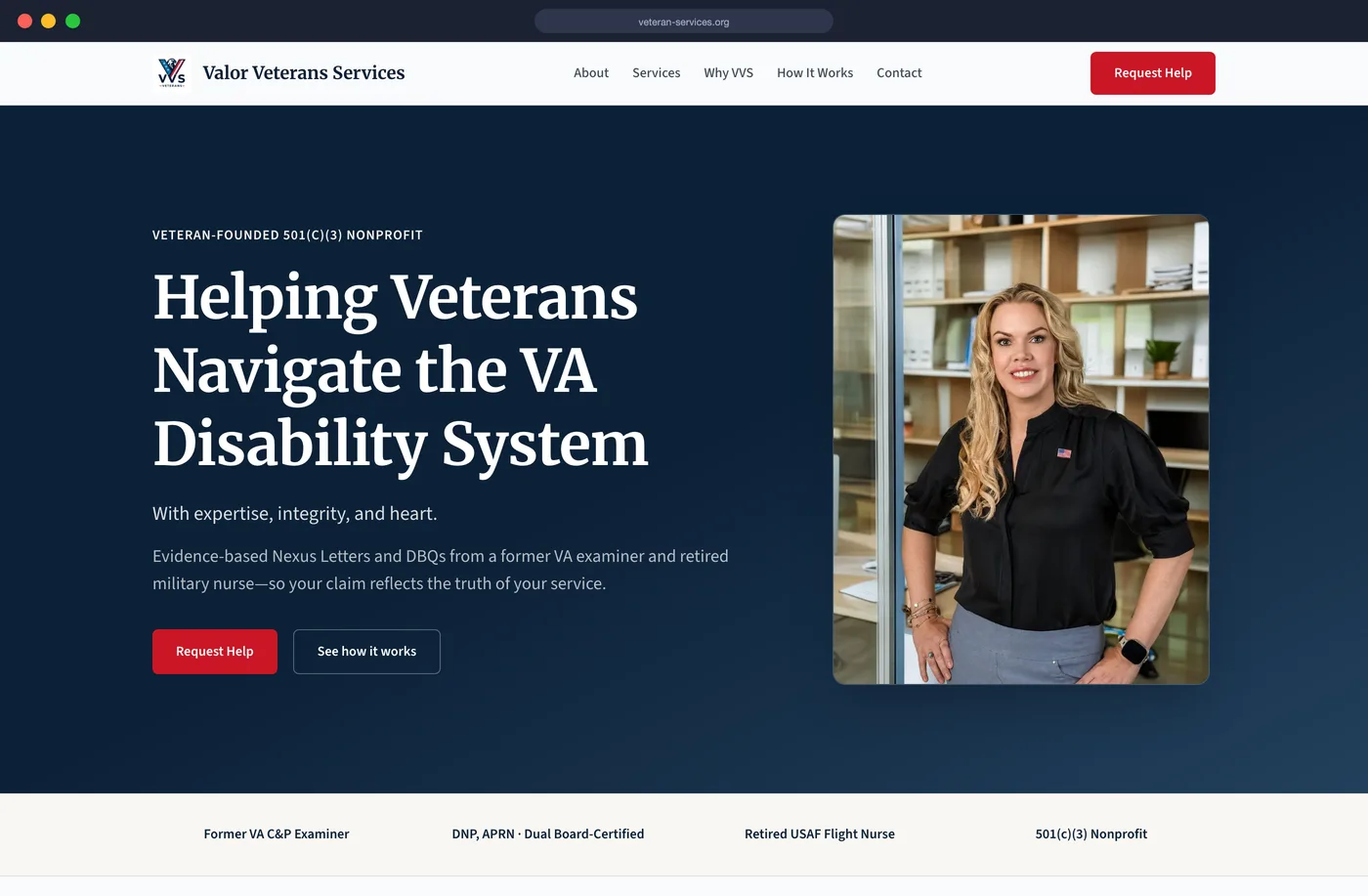
Valor Veterans Services is a veteran-founded nonprofit. Its founder is a retired Air Force flight nurse and former VA Compensation and Pension examiner who writes the independent medical evidence, including nexus letters and disability questionnaires, that supports veterans’ claims.
Doing that work means veterans have to send in service treatment records, diagnoses, and medical history. Under HIPAA, that is protected health information, and it cannot be collected through an ordinary web form or a shared folder link. The organization needed a public website that could accept those records without ever becoming a place where they could leak.
The Solution
We built the intake around a single design rule: the website can receive documents but can never read them.
Files travel from the veteran’s browser directly into encrypted storage, bypassing the web server completely. The server issues a short-lived, tightly scoped upload permit and never sees a single byte of file content. Even a total compromise of the public website would not expose a medical record, because the records were never there.
Staff read submissions through a separate authenticated dashboard, with multi-factor authentication required before any protected page will render.
What We Built
Direct-to-Storage Intake
Document bytes never pass through the web server or the hosting platform. The browser uploads straight into encrypted storage using a permit that expires in minutes.
Encryption and Storage Controls
Every object is encrypted on arrival with managed keys. Storage is versioned, closed to public access, and restricted to an explicit list of principals.
Authenticated Staff Dashboard
A managed identity service with multi-factor authentication enforced. The session is checked before any protected page renders, not after.
Server-Rendered Public Site
Seven marketing pages rendered on the server, so the organization is visible to search engines and AI crawlers rather than hidden behind client-side JavaScript.
PHI-Free Notifications
Staff get alerted the moment a submission lands. The alert deliberately carries no protected health information, only the fact that something arrived.
Audit Trail
Access logging retained for two years, so the organization can answer who looked at what, and when, long after the fact.
Technology Stack
Application
- ✓ Next.js with the App Router, server-rendered
- ✓ TypeScript across the whole data path
- ✓ React and Tailwind CSS for the interface
- ✓ Managed hosting with instant rollback
Security and Compliance
- ✓ HIPAA-eligible AWS services under a signed Business Associate Addendum
- ✓ Encrypted object storage with managed keys
- ✓ Managed identity with enforced multi-factor authentication
- ✓ Signed, short-lived session tokens
Eight production dependencies in total. No CMS, no ORM, and no UI component framework. Everything in the path that touches protected health information is either an official AWS SDK or a focused cryptography library, which keeps the audit surface small. That matters when the system handles medical records.
Why It Was Built This Way
Uploads are permitted, not trusted
The upload permit embeds a maximum file size, so storage itself rejects anything oversized rather than trusting the size the browser claims. We verified it by declaring a small size and then attempting a much larger upload. Storage refused it.
The server assigns the identifiers
Submission identifiers are generated on the server, never accepted from the browser. Because identifiers appear in upload permits, accepting one from the client would have let anyone who observed an identifier request permission to write into another veteran’s folder.
Outcome
The site is live at veteran-services.org. Veterans can send their records from a phone in a few taps, staff review them behind an authenticated dashboard, and the public website never becomes a place where a medical record can sit.
This is the kind of work that does not belong on a monthly plan. It was scoped and quoted as a fixed-bid project, and built against a written technical design document covering the security architecture in full.
Handling sensitive data?
Medical records, financial documents, or anything else where a leak is not survivable. Tell us what you need and we will quote it in 48 hours.
Get a custom quote →